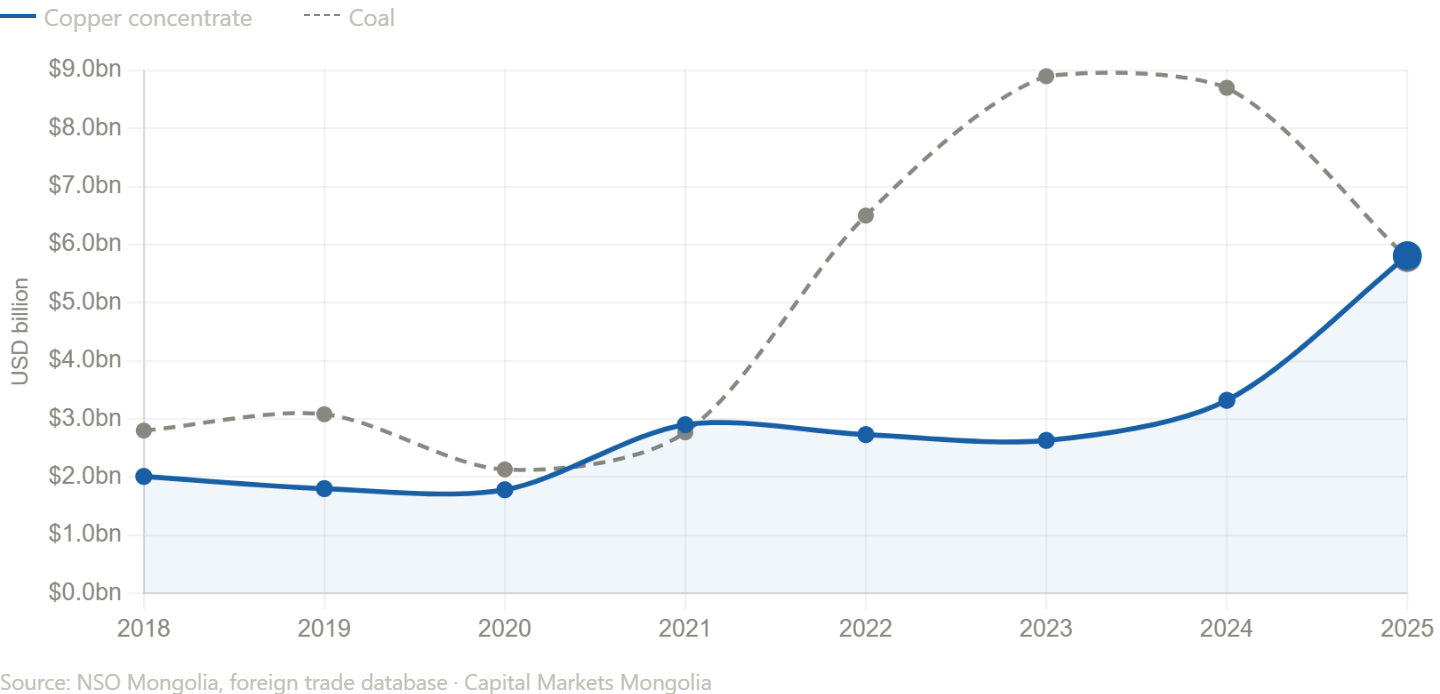
In 2025, copper overtook coal as Mongolia’s largest export earner for the first time since during the COVID-19 Pandemic. That shift was a decade in the making, and this demands investor attention.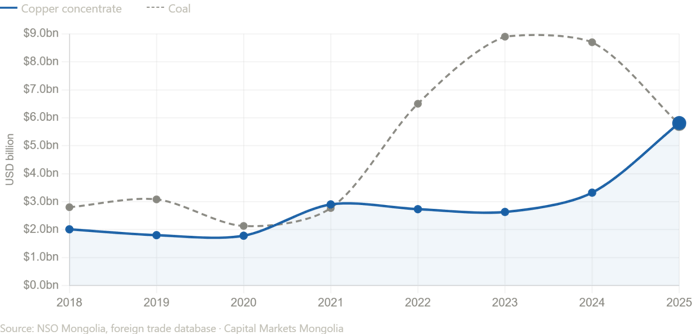
Copper concentrate exports generated $5.83 billion in 2025, a 76% increase in value compared to 2024. Coal revenues, despite record volumes, fell 33.7% to $5.77 billion. Mongolia’s two great extractive pillars tended to move broadly in tandem. Even in 2021, when copper briefly overtook coal, both were rising. After a heavy few years of coal, coal in 2025 sharply fell while copper surged.
The price environment explains part of it. Global copper futures jumped over 30% in 2025, reaching $12,960 per tonne by late December, before surging to a record $14,527.50 per metric ton on the LME in January 2026. AI-related copper demand, supply chain constraints, and tightening global inventories drove the rally. The International Copper Study Group abandoned its previous surplus projections and forecasts a 150,000-tonne deficit for 2026.
Price alone does not account for the magnitude of Mongolia’s surge. Volume rose, too. Rio Tinto’s annual records show that total copper production at Oyu Tolgoi climbed toward 200,000 metric tons in 2024, up from 168,000 metric tons in 2023. That increase reflects the underground expansion at Hugo North, which began producing in March 2023 and is ramping toward full output. Higher-grade ore from underground operations produces more copper per metric ton of rock. As global copper prices sustained a high baseline, averaging around $9,000 per metric ton in 2024, the aggregate metal value surged without matching operational cost increases. Oyu Tolgoi’s underground operations are economically superior to open-pit operations.
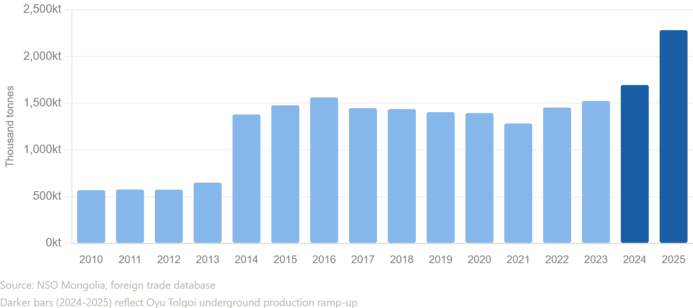
Many investors underappreciate Mongolia’s position in global copper. Mongolia holds the seventh largest copper resource in the world at 56.5 million metric tonnes, ranks thirteenth in production, and sixth globally in copper ore exports. That ranking discrepancy, between resource size and production output, is where investors ought to focus. Mongolia is not yet producing copper at the scale it could. Projections place Oyu Tolgoi as the world's fourth-largest copper mine by 2030, producing approximately 500,000 tonnes annually from 2028 to 2036. The World Bank's Mongolia Economic Update projects the country's economy to grow by 6.3% in 2025, supported by a surge in copper production following the expansion of underground operations.
One structural constraint remains unresolved. Mongolia exports nearly all of its copper production as raw material or copper concentrate, with limited domestic production of value-added products such as copper cathode. All of that concentrate travels to China. Mongolia exports its copper concentrates to the Chinese market via road and rail. For the present, they are dependent. A Khanbogd smelter project, designed to process one million tonnes of concentrate annually, is progressing through partner selection, but timelines remain subject to construction schedules and the economics of domestic processing.
The 2026 Minerals Law amendments introduce royalty offsets to support domestic smelting and refining facilities. The legislation incentivizes companies that transform raw concentrate into refined products, allowing them to capture higher profit margins and reduce logistical costs compared to shipping bulk raw ore. The policy presents Mongolia’s clear direction.
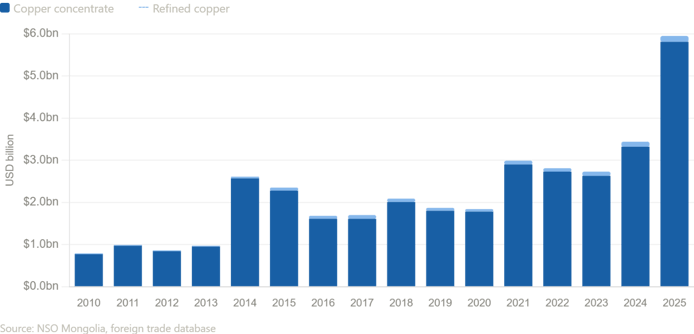
For investors, 2025 produced the clearest evidence to get into Mongolia’s copper economy. The 2025 rally shows a structural shift. If copper overtakes coal, copper anchors fiscal stability, supports the currency, and drives industrial growth.
Mongolian copper matters globally and increasingly does so. The question is how much value remains uncaptured before the consensus catches up.