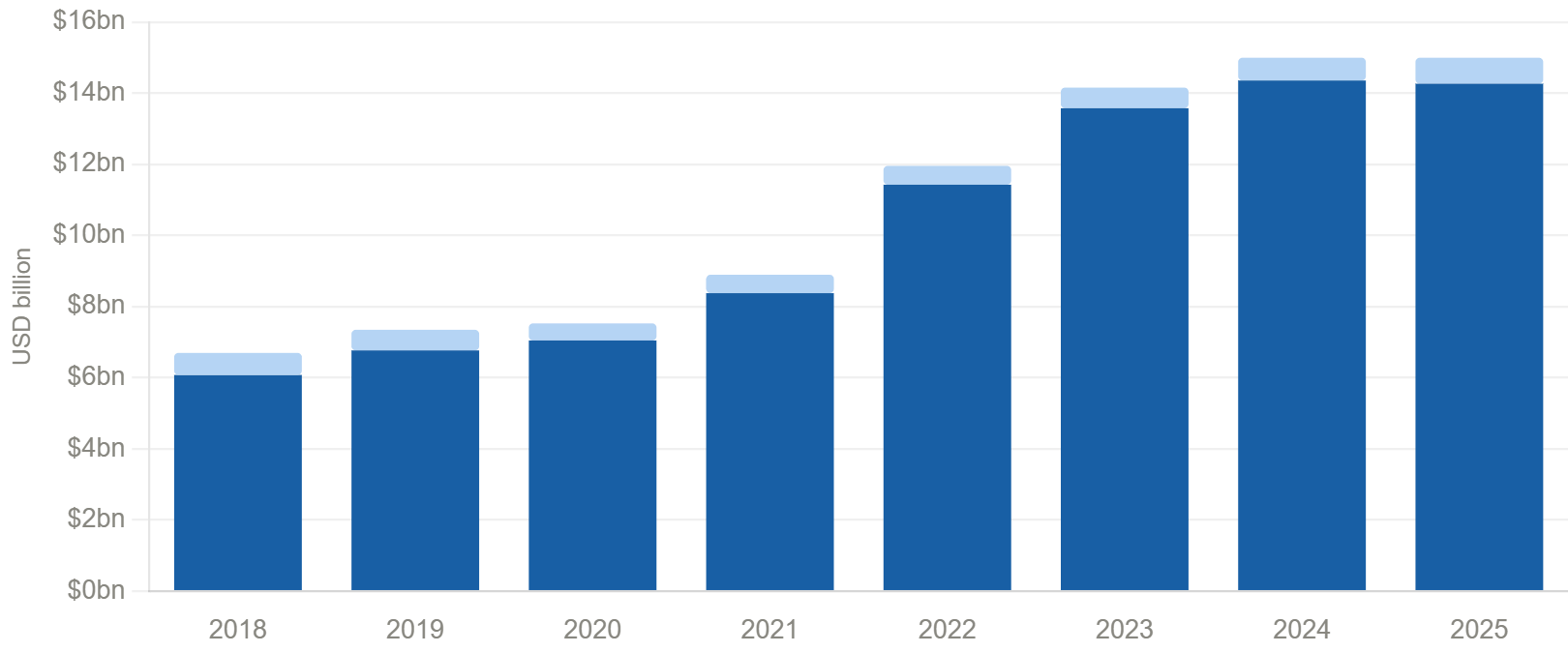
In 2025, Mongolia exported more than US$13 billion worth of coal and copper combined. Those revenues largely originated from mining in remote regions of the South Gobi, hundreds of miles from the capital. Yet the economic effects are most visible in Ulaanbaatar, where nearly half of Mongolia’s population lives. The connection between mining and urban growth is one of the country’s most important investment signals.
Mining remains the foundation of Mongolia’s economy. Mineral exports account for the overwhelming majority of export earnings, with copper and coal still leading the way. Underground production’s expansion at Oyu Tolgoi and improvements to coal transportation infrastructure have increased export volumes and, likewise, government revenues. Across the board, this income helps strengthen Mongolia through foreign exchange earnings and increases household incomes across the economy. These inflows particularly affect the nation’s capital.
Mining exports
Non-mining exports
Source: NSO Mongolia, foreign trade database. Mining = coal, copper, gold, iron, fluorspar, petroleum, molybdenum, zinc, refined copper.
Ulaanbaatar continues to attract migrants from rural provinces seeking employment, education, and access to services. The capital generates the majority of Mongolia’s economic output despite occupying a small share of its land area. As mining revenues circulate through wages, government spending, and private investment, demand for housing, commercial property, retail space, and urban infrastructure rises alongside them.
The housing market clearly illustrates this. Population growth and migration have sustained demand for apartments even during periods of economic volatility. Mortgage lending has expanded over the past decade, supported by government-backed housing programs and the development of Mongolia’s housing finance system. The 2024 investment figure of US$52.2 million nearly matches the last peak of US$53.4 million recorded in 2013, at the height of the prior mining boom. As incomes rise, homeownership becomes attainable for more people, creating additional demand for residential construction.
2022-2024 recovery
Prior cycles
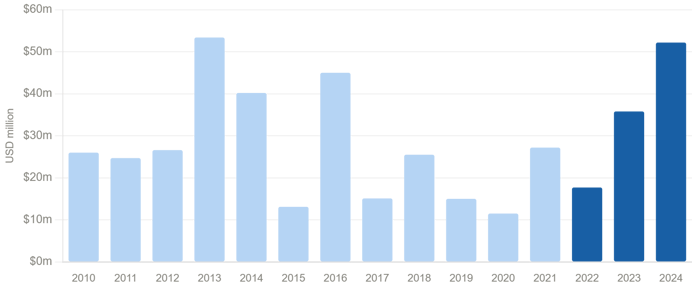
Source: NSO Mongolia, investment in real estate activity statistics
Commercial real estate has followed a similar trajectory. Higher incomes generated by mining activity support growth in retail, hospitality, and office space. New businesses emerge to serve expanding urban populations. Banks, professional services, logistics companies, and retailers benefit from increased economic activity that originates far from the growing mining sector.
Infrastructure investment reinforces these trends. State news acknowledged regarding the 2026 budget, “Capital expenditure recorded the strongest growth, rising 72.5% to MNT 1.9 trillion, led by higher spending on construction projects, major repairs, and other capital investments.” Roads, utilities, logistics facilities, and public services require continuous expansion for urban growth. Mining revenues have helped finance many of these improvements, while private developers continue to invest in residential and commercial projects across the capital.
One structural constraint remains unresolved. Housing supply has struggled to keep pace with demand. Rapid urbanization pressures the infrastructure and contributes to congestion. While these challenges create policy risks, they also highlight the scale of unmet demand that continues to exist in the market.
Investors often focus on Mongolia’s mines, deposits, and commodity exports. Those assets remain central to the country’s future. Yet the secondary effects of mining prove important. Export revenues generate demand for housing, commercial property, infrastructure, and urban services. The mines sit in the Gobi, but much of their value accumulates in the city.
Mongolia’s urban growth is inseparable from its mining. Investors must recognize mining shapes the economy. They are undervaluing the resulting urban transformation.