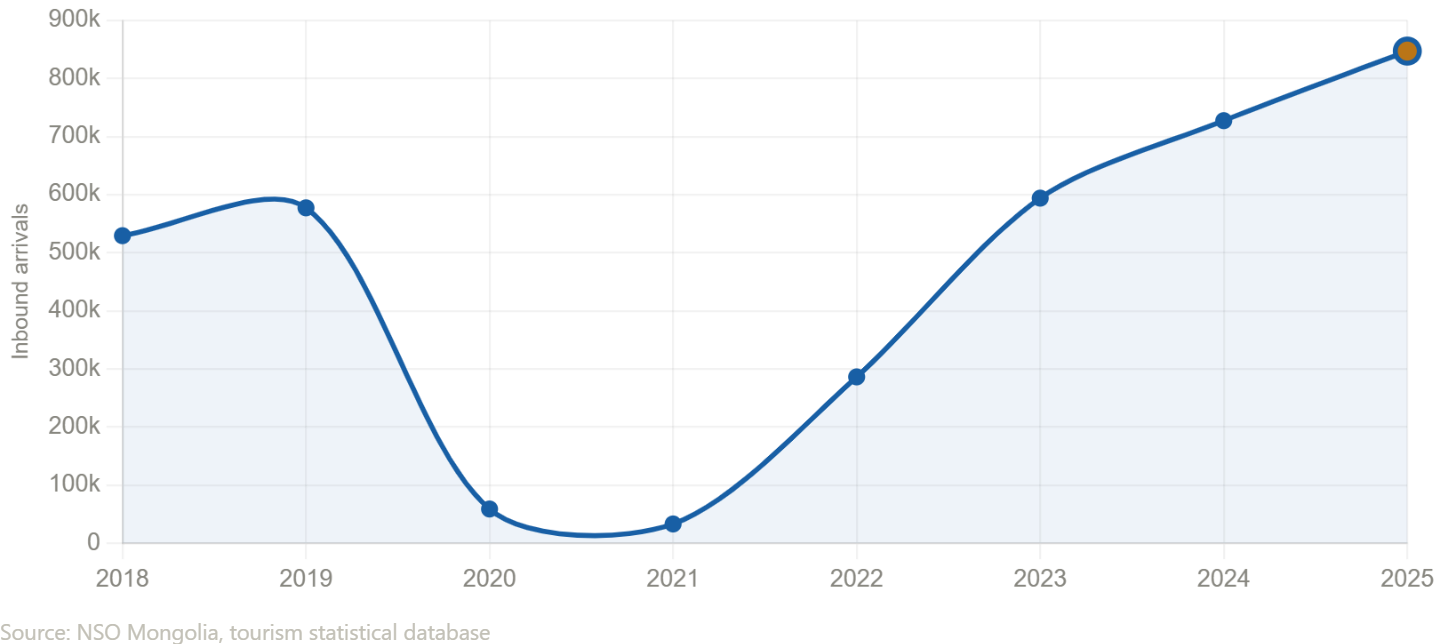
Mongolia recorded a record number of visitors last year, consistently up in recent years. Mongolia is reaching East Asian markets in its inbound service economy. Mongolia is tapping into its own soft power, and numbers reflect it.
The National Statistics Office of Mongolia recorded an all-time high of total annual visitor arrivals of 847,170 persons in 2025. For context, this represents a surge from the post-pandemic floor of 33,100 visitors in 2021 and a near-tripling of the 286,282 inbound tourists recorded in 2022.
Inbound tourist arrivals 2018-2025, with a clear 2025 record
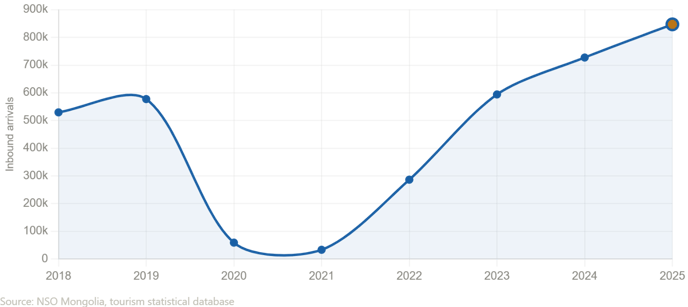
As we noted before, the Mongolian government has taken the initiative to increase the world’s awareness of its tourism thanks to its Go MonGOlia campaign. Although the Edelman survey claimed that in 2018, “only 10% of people knew Mongolia was a country, while 3/10 thought it was part of China,” Mongolia still received that year over 500,000 tourists. Just under 10 years later, that figure has nearly doubled.
South Korea has become one of the three dominant source markets alongside Russia and China. The past three years rapidly solidified that position. NSO data for the first half of 2025 recorded 328,395 total international inbound tourists, with South Korea a large proportion, right behind China and Russia. Growth has sustained. Early 2026 arrivals were running 33% ahead of the same period in 2025, according to the Mongolian Tourism Organisation.
While many Western allocators have looked for mining assets, Mongolia has leveraged East Asian media consumption trends to build a consumer brand. News outlets carried stories of Mongolian athletes’ outfits both at the Paris 2024 and Milano Cortina 2026 Olympics. High-profile South Korean shows, most recently such as 2025’s Physical: Asia, and variety shows filmed on the Mongolian steppe are successfully casting the country as both a remote destination and an attainable one for urban professionals. This year’s follow-up, Physical: Welcome to Mongolia, underscores that interest.
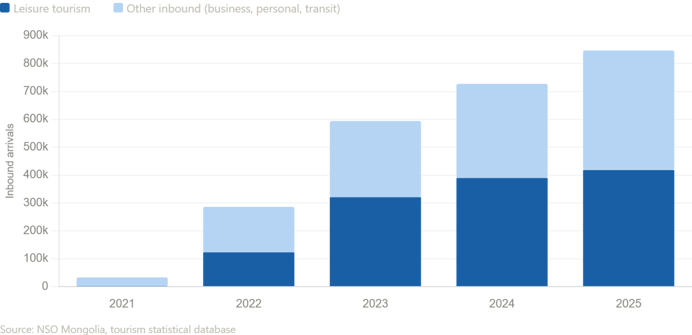
Post-pandemic growth trajectory 2021-2025, showing both total inbound and pure tourism visitors side by side
This soft power push creates a self-reinforcing cycle for aviation infrastructure, as real consumer demand follows. Historically, national carriers controlled the Seoul-Ulaanbaatar route tightly. This artificially suppressed visitor numbers through high ticket prices. The post-pandemic arrival of low-cost carriers, including Jeju Air and T’way Air, drove competitive pricing and significantly increased flight frequency on the route. Seven airlines now operate direct services between Seoul and Ulaanbaatar, according to current booking platform data, compared with a far more limited field before the pandemic.
For the investor, this tourism data proves that the Mongolian economy’s diversification efforts into tourism appear to be working. Tourism provides another source of foreign exchange. This year, as Mongolia welcomes the 17th session of the Conference of the Parties (COP17) to the UN Convention to Combat Desertification. The service sector infrastructure is active to meet this demand. Allocators who act before this consumer economy reaches institutional scale will capture the primary value creation.